|
m7G Controls Translation and LSC Survival
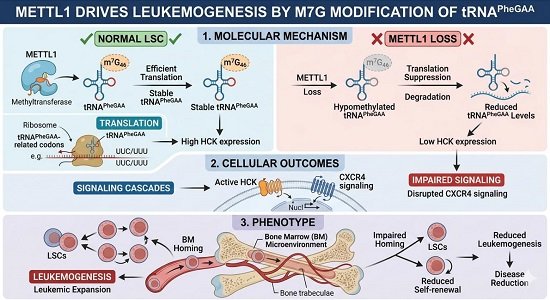
The study, led by Dr. Rui Su's group at City of Hope, showed that LSCs are highly dependent on METTL1, the enzyme that catalyzes tRNA m7G modification. Using TRAC assay to quantify tRNA m7G modification, they found that METTL1 loss depleted m7G-modified tRNAPheGAA, resulting in ribosome stalling, activation of the No-Go Decay (NGD) pathway, and impaired HCK translation. As a result, CXCR4 signaling is disrupted, preventing LSCs from homing to the bone marrow and ultimately impairing their self-renewal.
First-in-Class METTL1 Inhibitor Shows Therapeutic Potential
The authors identified M1i (NSC137443) as a potent METTL1 inhibitor that suppresses tRNA m7G modification. In AML mouse and patient-derived xenograft models, M1i selectively eliminated leukemia stem cells while largely sparing normal hematopoietic stem cells, highlighting the METTL1–m7G axis as a promising therapeutic target.
Advance m7G Research with Arraystar TRAC-seq
This study highlights the critical role of tRNA m7G modification in translational regulation and cancer stem cell biology. Arraystar TRAC-seq provides transcriptome-wide, single-nucleotide profiling of m7G-modified tRNAs, enabling researchers to investigate METTL1-mediated translation in cancer and other diseases.
Key Advantages
• Transcriptome-wide profiling of tRNA m7G modifications
• Single-nucleotide resolution
• Quantitative comparison across biological conditions
• Publication-ready bioinformatics analysis
|